Returning to Pomarico
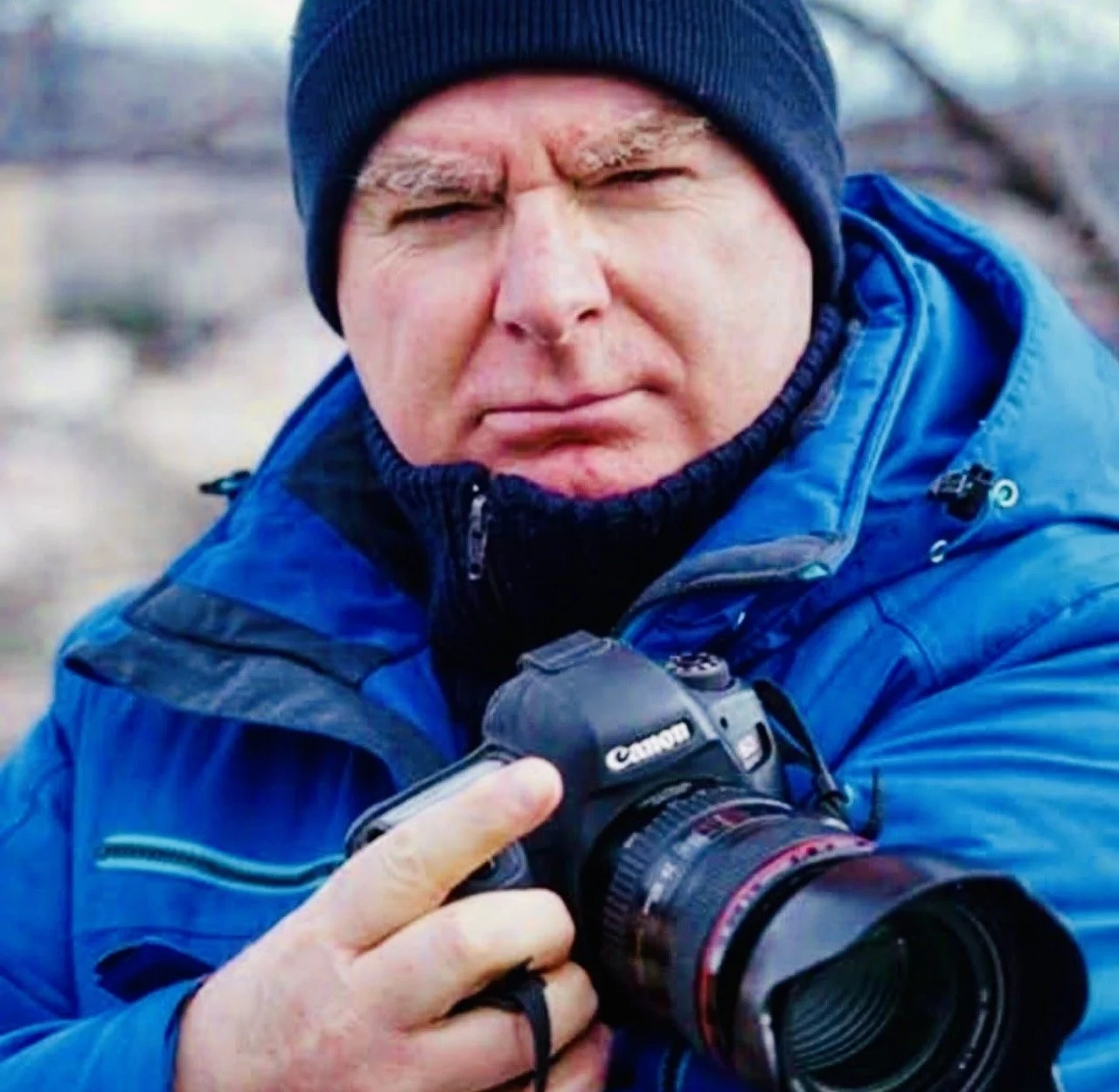
We left the Adriatic city of Bari and headed inland toward Pomarico, the poor Basilicata hill town my grandfather left behind more than a century ago.
By now, on my latest return to southern Italy, I know this rhythm by heart. I sit in the back. Mike drives. Bruno, as always, claims the front passenger seat—narrating the latest village gossip.
Which old men from the benches around town had passed on? Who will become the town’s next mayor? Who’s been asking about the American writer whose grandfather left Pomarico nearly 120 years ago?
This year, I published a memoir about my search for the family my grandfather left behind. The book, In the Land of the Midday Sun: An American Grandson’s Search for His Southern Italian Roots, chronicles my grandfather’s early life before he boarded a steamship for New York in 1905 at age 17.
I could not have written the book without these two distant cousins, who adopted both me and the project as their own. Together, we became an unlikely reporting team in a town that never had its own newspaper.
Mike drove and translated my interviews, drawing on the English he’d learned living in Brooklyn as a young man. Bruno—restless, funny, endlessly curious—worked the edges of every scene with his camera.
My grandfather had left. I wanted to understand the people who stayed.
That summer, we killed entire afternoons drifting through the countryside. We wandered narrow backroads, laughing, stopping at ancient fountains, eating fruit so ripe the juice ran down our faces.
Somewhere along the way, they became family.
And now we were together again, slipping easily back into our old roles: Mike drove. Bruno talked. I listened.
Change comes slowly in Pomarico, if at all.
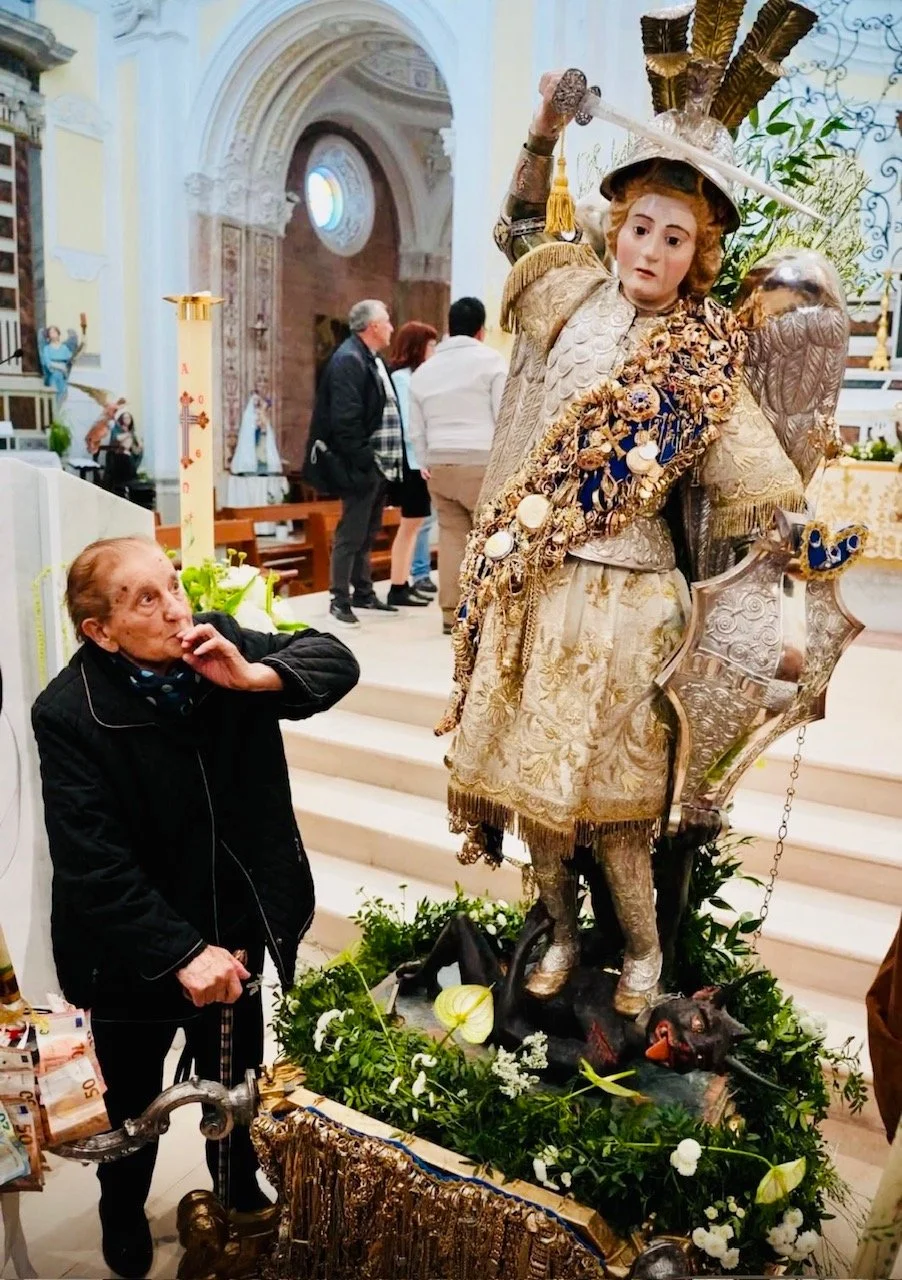
I had not planned to return in early May, when spring can still turn cold overnight, but Bruno insisted I come for the Festival di San Michele Archangel—a centuries-old spectacle of rural ritual, fierce competition and village pride.
It is also a homecoming. Pomarico’s scattered sons and daughters return from across Italy and America. The narrow streets fill with families. Bands play. Men compete for the honor of carrying San Michele on their shoulders.
For a few days, Pomarico celebrates itself and remembers what it survived.
In the 1700s, famine devastated Pomarico. Wells dried up. Locusts devoured the fields. According to village legend, an elegant stranger appeared in a nearby town to purchase eight wagonloads of food, leaving a diamond ring as collateral.
The wagons arrived just as Pomarico was collapsing from hunger. Villagers surged forward, clawing and shoving for what they could carry.
Only later, the story goes, did they realize the mysterious stranger had been Saint Michael the Archangel himself.
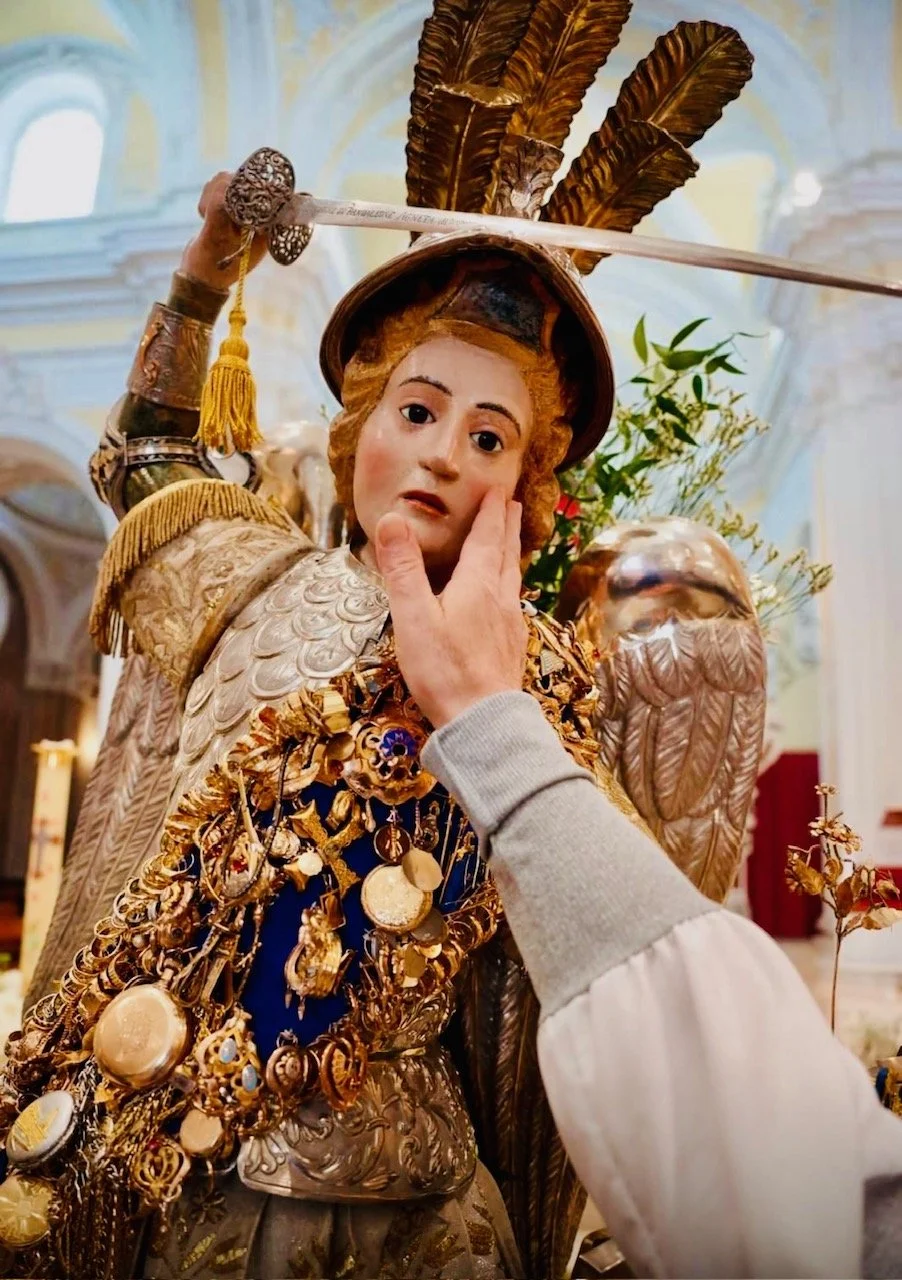
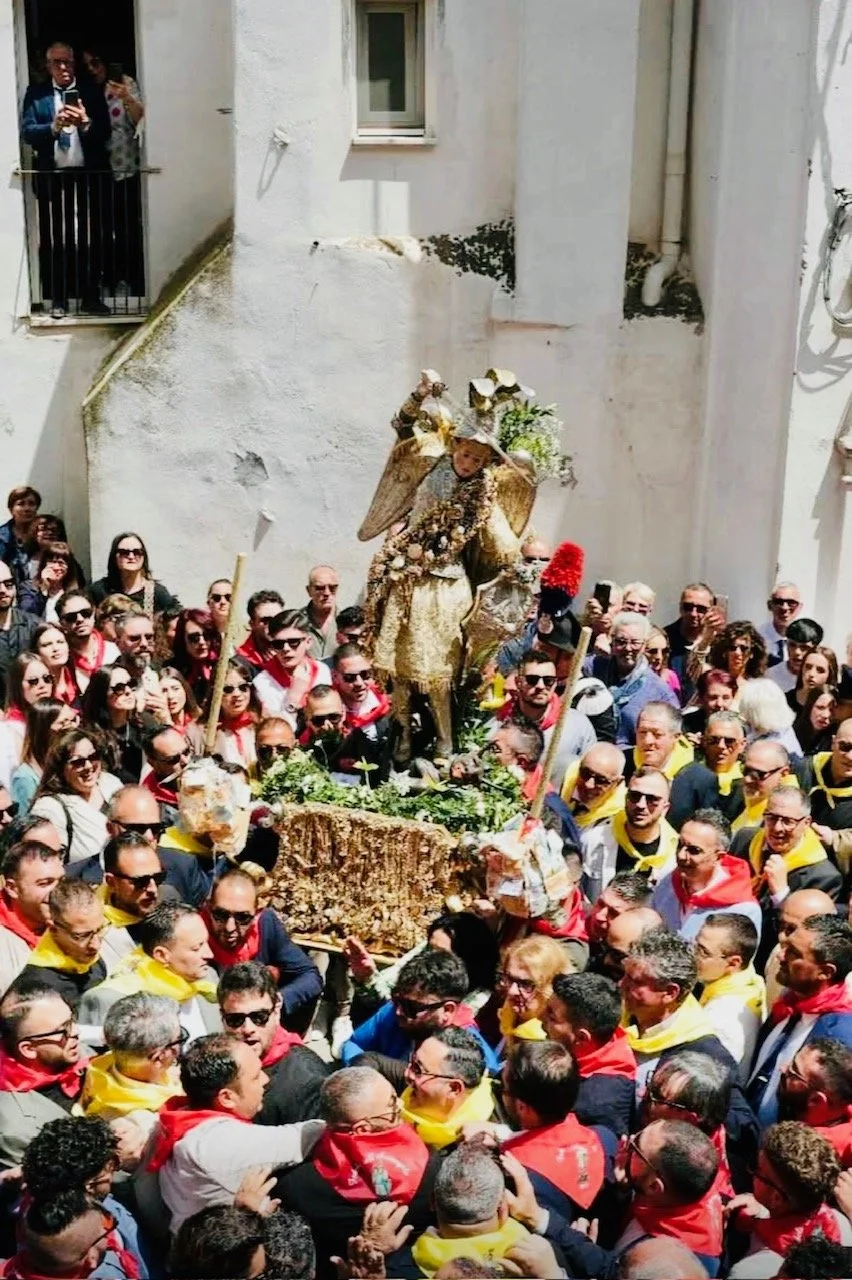
Throughout the festival, the statue remains the center of things. Families argue for the honor of carrying the saint through Pomarico’s steep streets, raising money for the privilege weeks in advance. For hours, processions inch uphill through packed crowds until carriers emerge drenched in sweat, exhausted and proud.
Bruno lives for these three days each year. Taking leave from his job as a regional policeman, he races through the crowds photographing every procession and church service tied to San Michele. For him, the archangel is not a symbol but something alive.
Mike, on the other hand, prefers the edges of things. So he and I stayed mostly on the margins as San Michele rose above the crowd on a platform balanced across dozens of shoulders. Celebrants carried the saint uphill, down again, then up the next rise, with the faithful pressed in behind.
At one point, as the procession trudged slowly up a steep hill in the town’s historic district, Mike turned to me.
“So, do you want to follow them?”
“Let’s wait until they come back down,” I said.
And when the procession returned, Bruno was out front, camera raised, chasing the saint from every angle.
Later, at dinner, half teasing, I asked Bruno whether San Michele was a real person, some long-dead holy man who once walked these streets.
He looked at me, eyes wide.
“No,” he said. “San Michele is an angel!”
I did not question him.
Abbiamo lasciato Bari, città adriatica, e ci siamo diretti verso l'entroterra, verso Pomarico, il povero borgo collinare basilicano che mio nonno si lasciò alle spalle più di un secolo fa.
Ormai, al mio ultimo ritorno nel sud Italia, conosco questo ritmo a memoria. Io siedo dietro. Mike guida. Bruno, come sempre, si accaparra il sedile del passeggero anteriore, raccontando gli ultimi pettegolezzi del paese.
Quali vecchietti seduti sulle panchine del paese sono scomparsi? Chi sarà il prossimo sindaco? Chi ha chiesto notizie dello scrittore americano il cui nonno lasciò Pomarico quasi 120 anni fa?
Quest'anno ho pubblicato un libro di memorie sulla mia ricerca della famiglia che mio nonno ha lasciato. Il libro, "Nella terra del sole di mezzogiorno: alla ricerca delle radici del Sud Italia da parte di un nipote americano", racconta la giovinezza di mio nonno prima che si imbarcasse su un piroscafo per New York nel 1905, all'età di 17 anni.
Non avrei potuto scrivere il libro senza questi due lontani cugini, che hanno accolto me e il progetto come se fossero parte della loro famiglia. Insieme, siamo diventati un'improbabile squadra di giornalisti in una cittadina che non ha mai avuto un proprio giornale.
Mike guidava e traduceva le mie interviste, attingendo all'inglese che aveva imparato vivendo a Brooklyn da giovane. Bruno, irrequieto, divertente, infinitamente curioso, si muoveva ai margini di ogni scena con la sua macchina fotografica.
Mio nonno se n'era andato. Volevo capire le persone che erano rimaste.
Quell'estate, abbiamo trascorso interi pomeriggi vagando per la campagna. Percorrevamo stradine secondarie, ridendo, fermandoci ad antiche fontane, mangiando frutta così matura che il succo ci colava sul viso.
In qualche modo, lungo il cammino, sono diventati parte della mia famiglia. E ora eravamo di nuovo insieme, riprendendo con naturalezza i nostri vecchi ruoli: Mike guidava. Bruno parlava. Io ascoltavo.
A Pomarico il cambiamento è lento, se non addirittura assente.
**
Non avevo programmato di tornare a inizio maggio, quando la primavera può ancora diventare fredda da un giorno all'altro, ma Bruno ha insistito perché venissi per la Festa di San Michele Arcangelo, uno spettacolo secolare di rituali rurali, competizione agguerrita e orgoglio cittadino.
È anche un ritorno a casa. I figli e le figlie di Pomarico, sparsi in tutta Italia e in America, tornano a casa. Le stradine si riempiono di famiglie. Le bande suonano. Gli uomini si contendono l'onore di portare San Michele sulle spalle.
Per alcuni giorni, Pomarico celebra se stessa e ricorda ciò che ha superato.
Nel Settecento, la carestia devastò Pomarico. I pozzi si prosciugarono. Le locuste divorarono i campi. Secondo la leggenda del villaggio, un elegante straniero apparve in una città vicina per acquistare otto carri di cibo, lasciando un anello di diamanti come garanzia.
I carri arrivarono proprio mentre Pomarico stava crollando per la fame. Gli abitanti si precipitarono, spingendosi e accalcandosi per accaparrarsi ciò che potevano portare.
Si narra che solo in seguito si resero conto che il misterioso straniero era stato San Michele Arcangelo in persona.
Durante tutta la festa, la statua rimane il fulcro di tutto. Le famiglie si contendono l'onore di portare in processione la statua del santo per le ripide vie di Pomarico, raccogliendo fondi per questo privilegio con settimane di anticipo. Per ore, le processioni si inerpicano lentamente in mezzo alla folla, finché i portatori emergono madidi di sudore, esausti ma orgogliosi.
Bruno vive per questi tre giorni dell'anno. Prendendosi un periodo di ferie dal suo lavoro di poliziotto regionale, si fa strada tra la folla fotografando ogni processione e funzione religiosa dedicata a San Michele. Per lui, l'arcangelo non è un simbolo, ma qualcosa di vivo.
Mike, invece, preferisce rimanere ai margini. Così io e lui siamo rimasti perlopiù ai margini mentre San Michele si ergeva sopra la folla su una piattaforma sorretta da decine di spalle. I celebranti portavano la statua in salita, poi giù, e infine su per la salita successiva, con i fedeli stretti dietro.
A un certo punto, mentre la processione si inerpicava lentamente su per una ripida collina nel centro storico della città, Mike si è rivolto a me.
«Allora, vuoi seguirli?»
«Aspettiamo che tornino giù», dissi.
E quando la processione fece ritorno, Bruno era in testa, con la macchina fotografica alzata, a inseguire il santo da ogni angolazione.
Più tardi, a cena, un po' per scherzo, chiesi a Bruno se San Michele fosse una persona reale, un santo morto da tempo che un tempo camminava per quelle strade.
Mi guardò con gli occhi spalancati.
«No», disse. «San Michele è un angelo!»
Non lo contraddissi.