
LLas Vegas loves to tell you a story.
It tells it in neon, in guided tours, in glass cases filled with wiretap equipment, guns and black-and-white photos of the men who built an empire in the desert. At the Mob Museum, where tickets run 35 bucks a pop, the city doesn’t hide its past. It packages it. Sells it. Profits off it.
The mob didn’t just pass through Las Vegas. It helped build it.
And today, that history is entertainment. But here’s where the story breaks down.
Because while Las Vegas cashes in on its outlaw past, the state still punishes real people they suspect are tied—sometimes loosely, sometimes not at all—to that same history.
My friend Frank Citro Jr. is one of them.
In 1988, he went to federal prison for loan-sharking and credit card fraud. He did his time. Paid his debt. Walked out and tried to move on. His crime didn’t happen in Las Vegas. There’s no proven record tying him to organized crime.
And yet Nevada put him in its Black Book—the state’s List of Excluded Persons.
That was nearly 40 years ago.
This week, he asked to be removed.
He wasn’t denied after a hearing. He didn’t even get a hearing.
That tells you everything.

I met Frank more than a decade ago when I was a reporter for the Los Angeles Times. I wanted to understand what it meant to live in Las Vegas—make a living there—and be barred from the casinos that define it.
He wasn’t a caricature. He wasn’t a legend. He was a working guy who had made mistakes, served his time, and was still living with the consequences decades later.
With his New Jersey accent, he plays the tough guy. But he knows exactly what this is: a life sentence without a courtroom.
That’s where the Black Book comes in.
It’s a government blacklist run by the Nevada Gaming Control Board and enforced by the Nevada Gaming Commission. If your name is on it, you don’t enter a casino. Period.
The stated purpose is to protect the integrity of gaming.
Fair enough.
But at some point, a system like that has to answer a basic question: What does it take to get off the list?
In Frank’s case, no one seems able—or willing—to say.
There is no clear standard. No defined path. No meaningful second look.
The contradiction would matter less if Las Vegas were consistent.
But it clearly is not.
The same city that markets organized crime as a tourist draw also maintains a system that can effectively exile a person for life—with no clear way out.
The contrast sharpens when you look at how different people are treated.
Powerful figures in the casino world have faced serious allegations or scrutiny over the years and continued to operate at the highest levels of the industry.
People like Steve Wynn, who stepped down amid sexual misconduct allegations.
Or Phil Ruffin, who has faced criticism over property and labor issues.
Or the late Sheldon Adelson, whose company paid tens of millions of dollars tied to a federal money-laundering investigation.
These aren’t identical cases. They don’t fall under the same rules as the Black Book.
But they show how flexibility follows power.
For someone like Frank Citro, there is no flexibility.
Just a decision that echoes across decades.
Frank wasn’t allowed to defend himself. He couldn’t even speak. Neither could his lawyers.
When decisions carry this kind of weight, they require transparency, evidence, and a real chance to respond.
He didn’t get one.
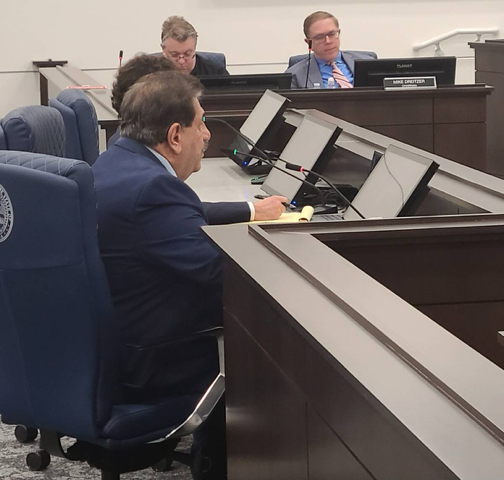
Commissioner Abbi Silver, a former Nevada Supreme Court justice, should understand the value of due process. Instead, she helped deny my friend a chance to make his case.
She called my friend a habitual criminal “with ties to seriously scary individuals.”
He hasn’t received so much as a parking ticket in four decades.
That’s when justice starts to look like branding, not principle.
On the same day that Frank was denied a hearing, commissioners voted to add Mathew Bowyer, a California-based illegal bookmaker, to its Black Book.
A bookmaker connected to a 2024 Major League Baseball betting scandal, who was involved in recent federal bookmaking cases involving MGM Resorts, Wynn Casinos and Caesars Palace.
That’s what the list is supposed to address—ongoing threats to the integrity of gaming.
Which raises the question: What exactly is it addressing in Frank’s case, nearly four decades later?
No one has answered that.
Instead, Silver said that Bowyer and another illegal bookmaker, Wayne Nix, were “absolute amateurs” when compared to my friend Frank.
Talk about a stacked deck.
“I’m very disappointed,” Frank told me. “After all these years, trying to do all the right things, they still put me in that category.”
“Criminals walk into casinos every day. I don’t have even a blemish on my record. What do I have to do to prove to these people that I’m not the man who made those foolish decisions 35 years ago?”

Las Vegas has built an industry on remembering its past. True to form, its Black Book is a system that never lets it go—for the little guy, anyway.
For Frank Citro, now 80—a grandfather with a sharp sense of humor and a damned fine singing voice—the reality is simple: .There is no clear way off the list.
Even after death, it’s not automatic. The state has to be satisfied you’re gone.
In a city built on reinvention, that’s a strange kind of permanence.